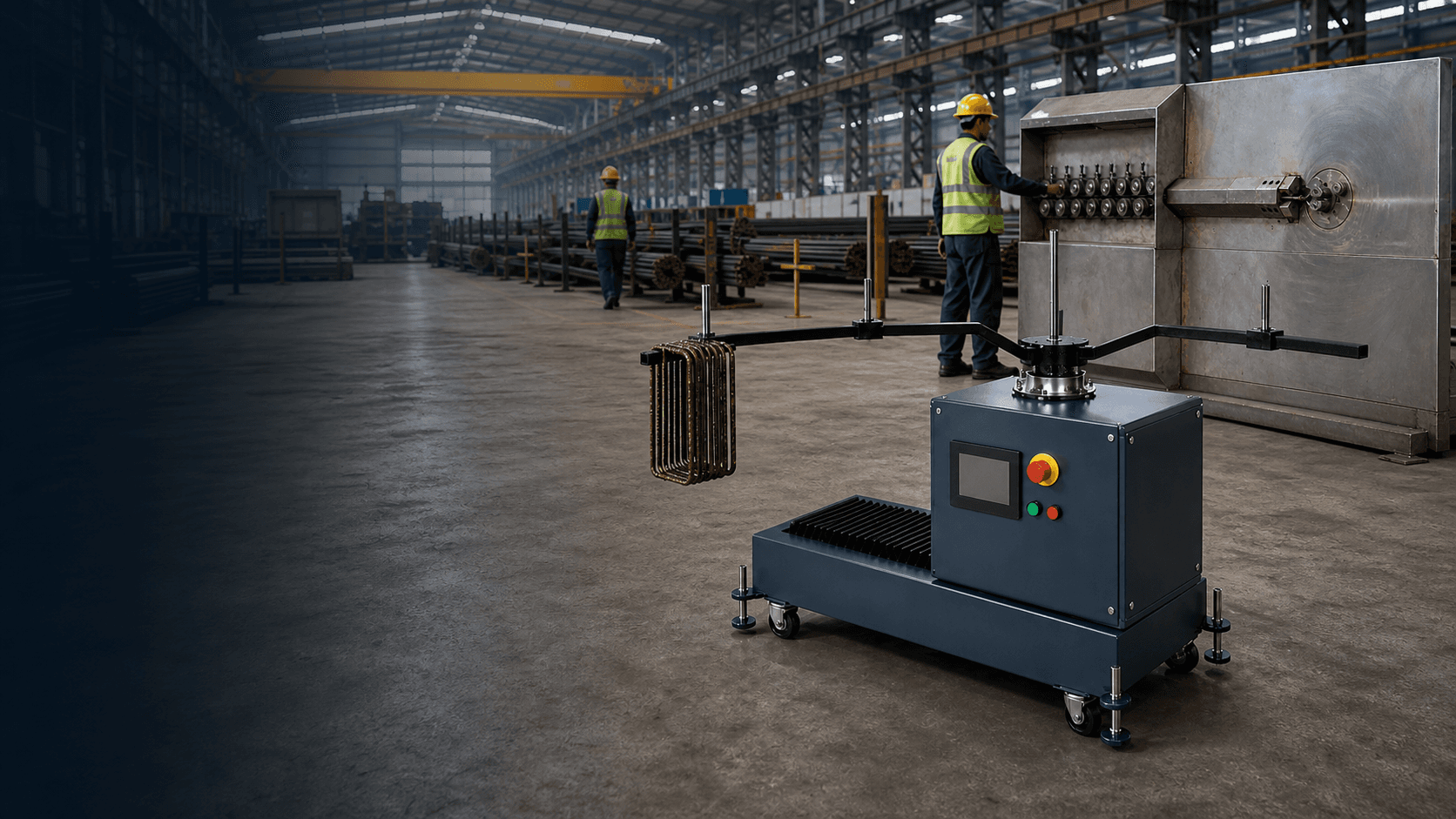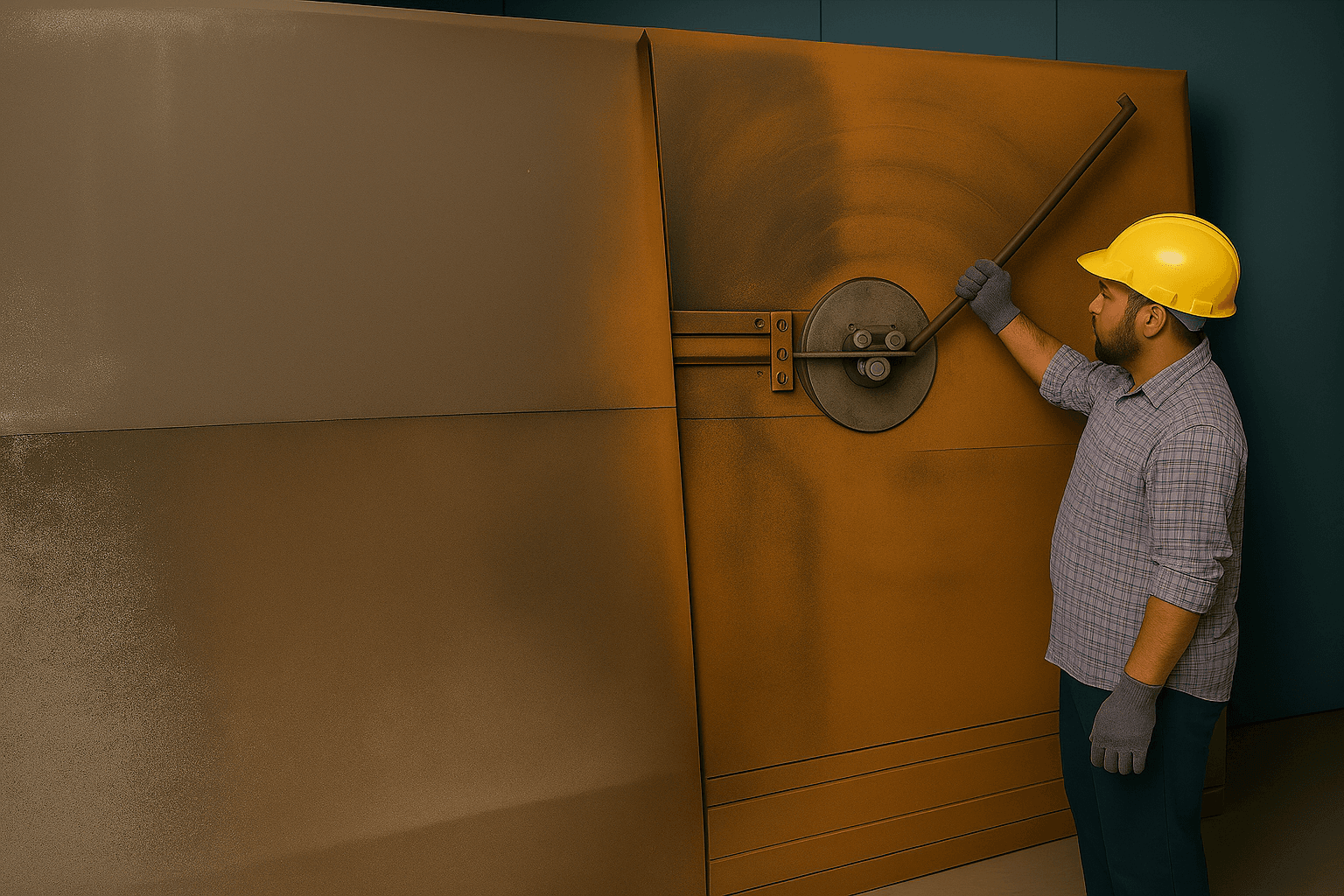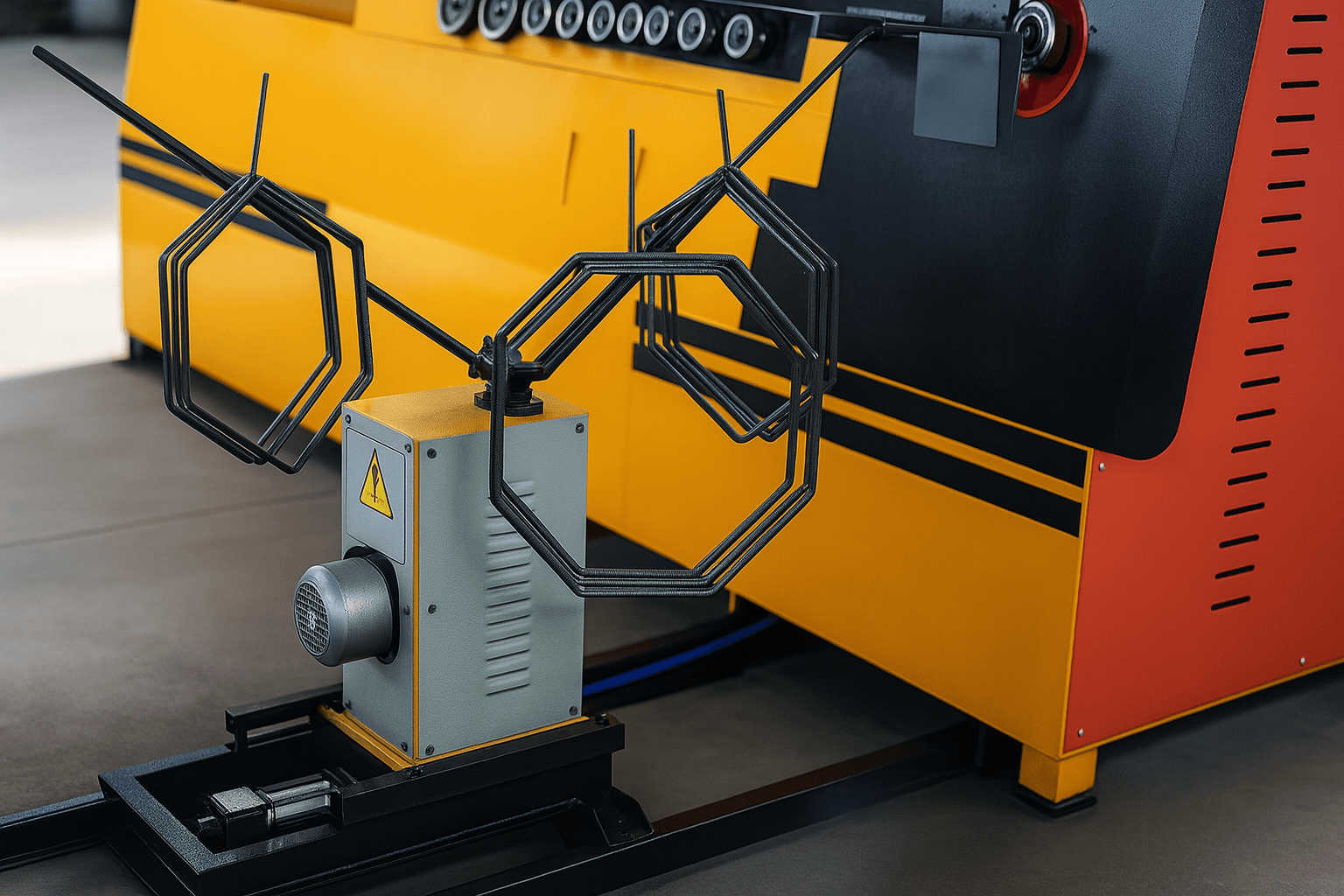
A bending machine produces finished stirrups continuously, and today that usually means someone stands at the discharge to collect them by hand, close to a machine that is still cycling. Ring Collector 2.0 does that job instead. Three arms index in turn so one collects while two hold finished stacks, collection can follow the bending cycle, and the operator unloads from the designated side of the installation.
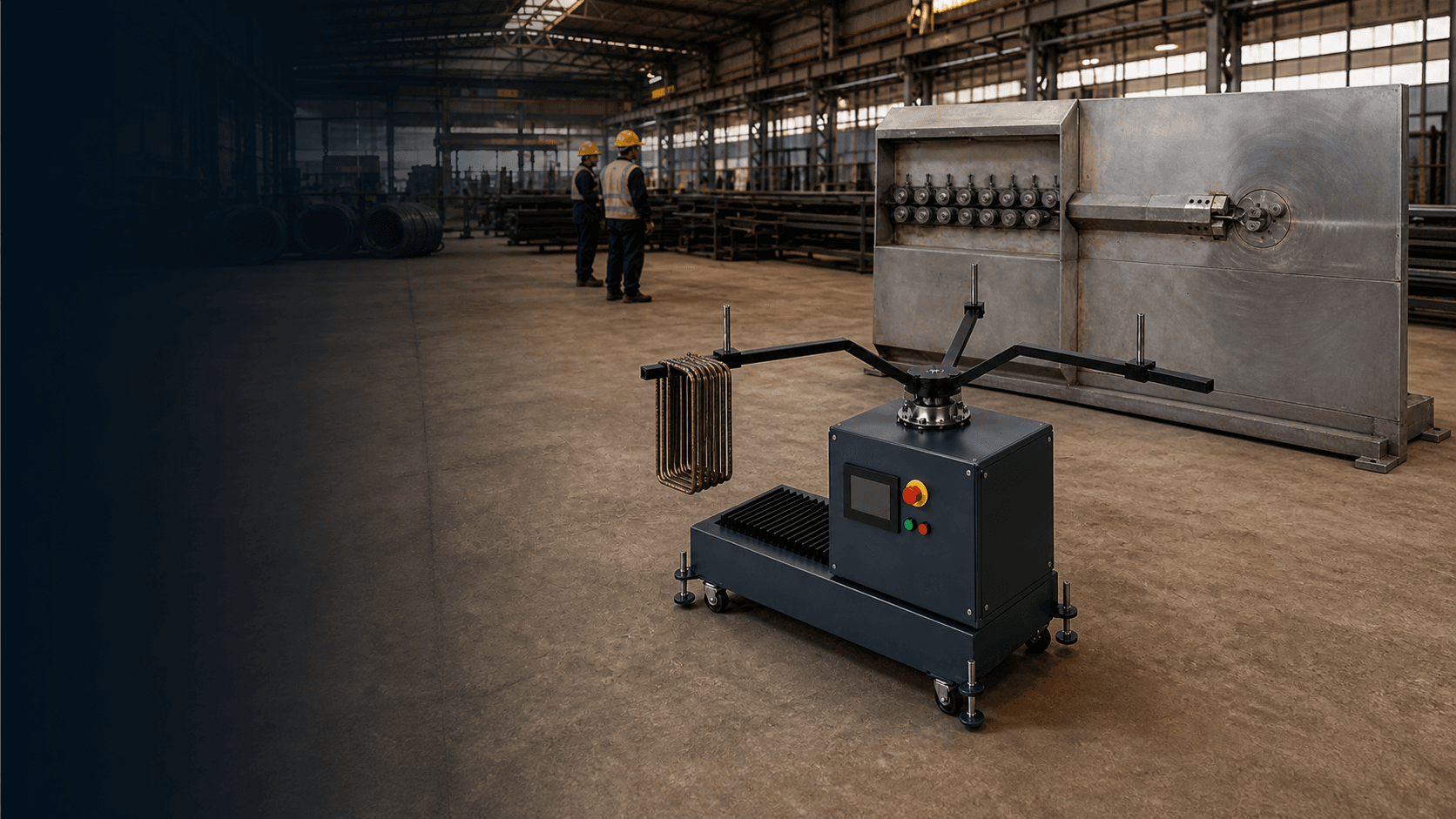
Ring Collector 2.0, in detail
A coordinated collection cycle, adjustable stacking and a movable base bring finished stirrups away from the bending discharge. The following features describe the Version 2.0 catalogue configuration.
01
Three arms that take turns
One arm collects while the other two hold finished stacks. Automatic indexing brings an empty arm into position when the set count is reached. The catalogue gives 30–36 rings across the collection cycle.
02
Catch, then retract
A pneumatic cylinder moves the arm assembly into the discharge position and retracts it before the next bend. The PLC handshake and timing are matched to your bending machine.
03
Set the working height
Screw-jack adjustment provides a nominal arm height of 1,200 mm with ±200 mm adjustment. Set and lock the height to suit the discharge geometry.
04
Roll into position, stand on the feet
Retractable wheels support repositioning between machines. For operation, the machine stands on its feet with the wheels lifted.
05
A counterweighted base
Weights in the base resist the pull and impact from collected stirrups. The catalogue arrangement does not require foundation bolts; verify positioning and floor conditions for the installation.
06
Choose the bundle size
Adjustable stoppers define the stack position, with up to 12 rings per arm. Ring geometry and the selected count determine the practical bundle arrangement.
07
Change the count at the machine
The on-board HMI and buttons let the operator set rings per arm locally. The PLC manages the count and indexing sequence.
08
Single- and double-coil production
The collection arrangement supports single- and double-coil rebar bending and square or rectangular rings. Confirm the actual ring geometry and discharge sequence during integration.
09
Protect the moving guides
Rubber bellows move with the sliding assembly and shield the guide rails and bearings from rebar dust and metal particles.
How it works
Bend. Catch. Stack. Turn.
STEP 01
Bend
The bending machine completes the programmed ring.
STEP 02
Catch
The collector receives the machine signal and moves into position.
STEP 03
Stack
Finished rings accumulate against the selected stopper position.
STEP 04
Turn
At the set count, the head indexes to the next arm.
Technical overview
Capacity & geometry
- Arms
- Three
- Rings per arm
- Up to 12
- Catalogue collection capacity
- 30–36 rings
- Arm height
- 1,200 mm ±200 mm
- Ring shapes
- Square and rectangular
Drive & operation
- Indexing
- Electric motor
- Traverse
- Pneumatic cylinder
- Control
- PLC in the panel
- Operator setting
- Rings per arm on the HMI
- Positioning
- Retractable wheels and feet
Plan the fit to your bending machine
Share ring sizes, discharge height, single- or double-coil operation, cycle timing and the available space. Installation includes the machine interface and setup, with a planned interruption to the connected machine for fitting. Operator training and documentation form part of the handover.
Discuss your application